WORLD'S FIRST TURNKEY HYBRID ELECTRO-CONVECTIVE R&D PLATFORM

Hybrid EHD Drying System

Combines high-voltage ionic wind boundary-layer disruption with controlled convective heating and humidity regulation in one programmable research chamber.
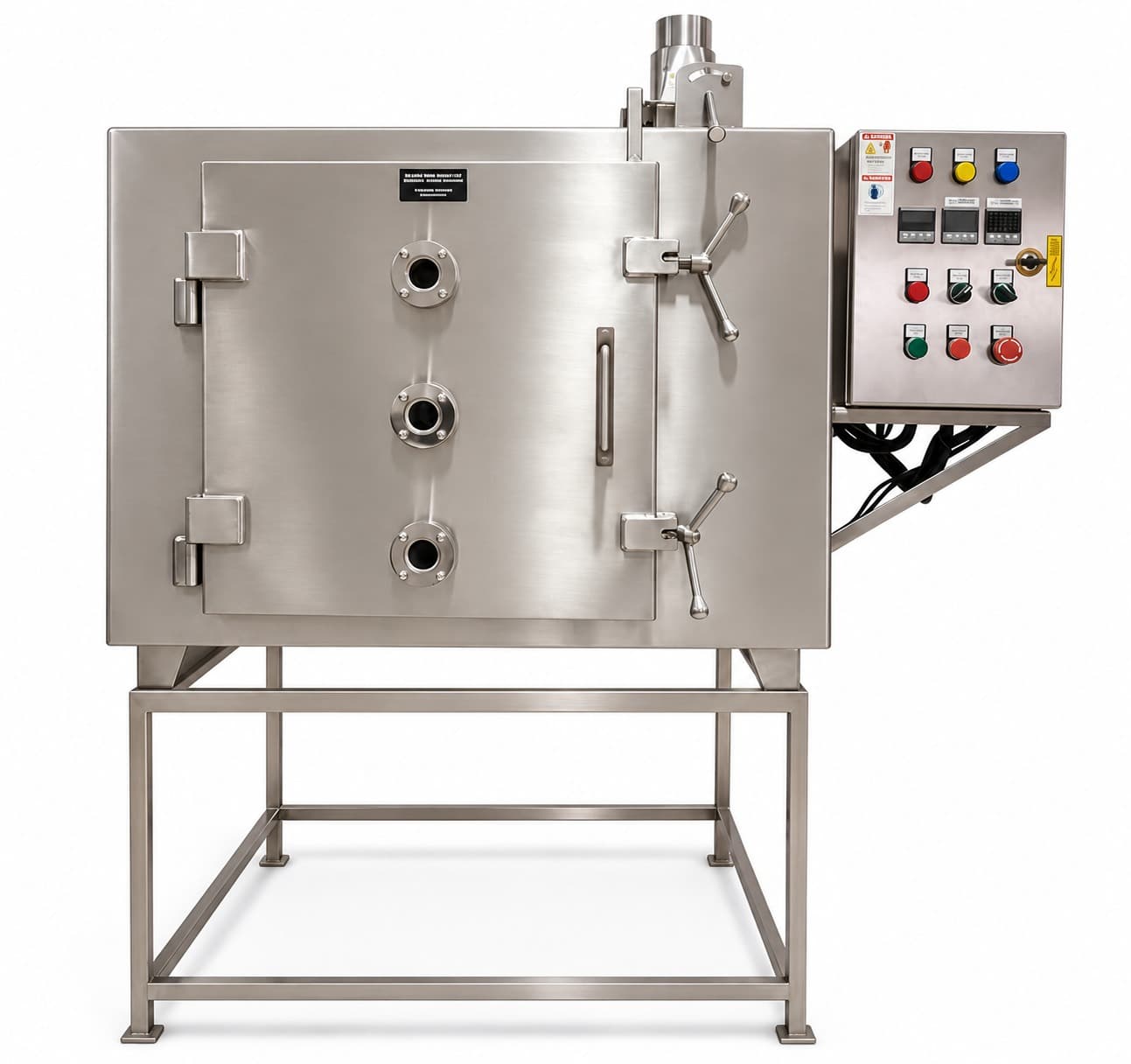
Hybrid electrohydrodynamic and convective drying chamber
ChamberHeater & Blower Module±30 kV HV Control

Coupled Electro-Convective Drying

Pairs convective thermal airflow with EHD ionic wind to accelerate drying at lower temperatures.

Programmable Multi-Stage Sequences

Run EHD-first (e.g., first 10 min), convective-first, simultaneous hybrid, or standalone baseline modes.

Live Gravimetric & Kinetic Suite

Continuous load-cell mass tracking, temperature/RH sensors, and automated thin-layer drying models.

EHD + Convective

Coupled Modes

±30 kV DC

Selectable Polarity

PID Temp + RH

Variable Airflow

World-First

Commercial Hybrid R&D Unit

SECTION 01 • VISUAL MECHANISM & SYNERGY

Why Hybrid EHD Beats Conventional Hot-Air Drying

Conventional hot air stalls against a stagnant surface moisture film. High-voltage ionic wind shatters that barrier so heat and moisture move freely at lower temperatures.

CONVENTIONAL HOT-AIR ALONE

Thick Stagnant Boundary Layer

Hot air flows over a stagnant humid layerHot airflow passes above a thick layer of humid vapor. Moisture accumulates between the airflow and the food sample.HOT AIR SKIMS ABOVE THE FILMSTAGNANT HUMID BOUNDARY LAYERFOOD SAMPLE123
  1. Laminar hot air slips over surface
  2. Trapped vapor slows moisture escape
  3. High heat needed → case hardening & bioactive loss

HYBRID EHD + CONVECTIVE

Ionic Wind Boundary-Layer Shear

Ionic wind shears the humid filmCorona emitters create downward ionic wind jets and micro-vortices. The thinned surface film releases vapor into the outgoing warm airflow.±30 kV CORONA EMITTERSWARM AIRVAPOR OUTFOOD SAMPLE123
  1. ±30 kV corona wind penetrates surface film
  2. Micro-turbulence accelerates vapor removal
  3. Faster drying at milder temperatures

01

Shorter Drying Time

Ionic wind reduces surface mass-transfer resistance, accelerating both constant-rate and falling-rate drying stages.

02

Lower Thermal Stress

Reach target drying rates at gentler air temperatures to limit surface crusting (case hardening) and shrinkage.

03

Higher Bioactive & Color Retention

Switch to non-thermal EHD during the falling-rate stage to protect vitamins, polyphenols, and natural color (ΔE).

04

Lower Specific Energy (SEC)

Improving heat transfer per watt of heater and blower input can reduce the total energy per kilogram of water removed.

Drying Kinetics

Moisture Ratio vs. Drying Time

Conventional Hot-Air OnlyHybrid EHD-Convective
Illustrative conventional and hybrid drying curvesBoth curves start at a moisture ratio of 1.0. The solid hybrid curve reaches 0.1 earlier than the dashed hot-air curve. A shaded band marks the difference in drying time at 0.1.1.00.50.1Moisture Ratio (MR)Drying TimeTIME SAVEDAT MR = 0.1

Shorter Drying Time + Higher Effective Diffusivity (Deff)

Illustrative curves. Estimate effective diffusivity from measured drying data.

SECTION 02 • VISUAL ZUKAN GUIDE

Four Programmable Hybrid Modes

Compare treatment sequences in one chamber with clear EHD and convective stages.

01

Simultaneous Hybrid

Convective heat and EHD ionic wind run together from start to finish.

CONTINUOUS OPERATION: EHD + Convective Flow. Boundary layer sheared continuously. Convective heat and EHD ionic wind run together from start to finish.CHAMBER PHYSICAL ACTIONCONTINUOUS OPERATIONEHD + Convective FlowEHD ON · HEATER ONBoundary layer shearedcontinuouslyCorona needlesWarm airflowSample traySYNCHRONIZED TIMING TRACKEHD (±30 kV)CONV.(Heat + Airflow)EHD ONHEAT + AIRFLOW ONSTARTEND

Outcome: Maximum drying-rate acceleration & lower operating temperature

02

EHD Pre-Treatment → Convective Finish

Apply an initial non-thermal EHD pulse (e.g., 10 min), then switch to controlled convective drying.

STAGE 1: EHD Pulse. Surface micro-channels opened without heat. STAGE 2: Convective Sweep. Rapid bulk evaporation. Apply an initial non-thermal EHD pulse (e.g., 10 min), then switch to controlled convective drying.CHAMBER PHYSICAL ACTIONSTAGE 1EHD PulseEHD ON · HEATER OFFSurface micro-channelsopened without heatSTAGE 2Convective SweepCORONA OFF · HEATER ONRapid bulk evaporationSYNCHRONIZED TIMING TRACKEHD (±30 kV)CONV.(Heat + Airflow)EHD PULSECONV. DRYINGtswitchSTARTEND

Outcome: Breaks initial surface resistance without thermal crusting

03

Convective Ramp → EHD Falling-Rate Finish

Start with a thermal warm-up, then switch to non-thermal EHD during the falling-rate stage.

STAGE 1: Thermal Ramp. Constant-rate removal of free surface moisture. STAGE 2: Non-Thermal EHD Finish. Protects bioactives & color ΔE while removing bound moisture. Start with a thermal warm-up, then switch to non-thermal EHD during the falling-rate stage.CHAMBER PHYSICAL ACTIONSTAGE 1Thermal RampCORONA OFF · HEATER ONConstant-rate removalof free surface moistureSTAGE 2Non-Thermal EHD FinishEHD ON · HEATER OFFProtects bioactives & color ΔEwhile removing bound moistureSYNCHRONIZED TIMING TRACKEHD (±30 kV)CONV.(Heat + Airflow)CONV. RAMPEHD FINISHtswitchSTARTEND

Outcome: Prevents case hardening & preserves heat-sensitive nutrients

04

Standalone Control Baselines

Run pure convective or pure EHD treatment inside the exact same chamber geometry.

BASELINE A: Pure EHD. Zero-heat control. BASELINE B: Pure Convective. Conventional thermal control. Run baseline A or B independently from start to end.CHAMBER PHYSICAL ACTIONBASELINE APure EHDEHD ON · HEATER OFFZero-heat controlBASELINE BPure ConvectiveCORONA OFF · HEATER ONConventional thermal controlSYNCHRONIZED TIMING TRACKRUN A OR BEHD (±30 kV)CONV.(Heat + Airflow)100% EHD · A ONLY100% CONV. · B ONLYSTARTEND

Outcome: Publication-grade apples-to-apples control datasets

Experimental Variables & Automated Outputs

Controllable Process Variables

  • HV Field: ±30 kV DC with selectable polarity and adjustable electrode gap
  • Thermal Loop: PID air temperature, blower velocity, and chamber RH%
  • Stage Timing: Programmable tswitch between EHD and convective phases

Automated Publication Metrics

  • Kinetics: Real-time moisture ratio (MR), drying rate (DR), and seven thin-layer models
  • Transport & Energy: Effective diffusivity (Deff), activation energy (Ea), and specific energy consumption (SEC)
  • Export: Time-stamped CSV/Excel logs for statistical analysis and RSM optimization

SECTION 03 • SYSTEM SUBSYSTEMS

Integrated Hybrid Lab Architecture

01 / CONVECTIVE & HUMIDITY LOOP

Controlled Thermal Airflow

  • •PID-regulated heaters
  • •Variable blower velocity
  • •Humidity regulation
PID Temp + RH

02 / HIGH-VOLTAGE EHD ARRAY

Ionic-Wind Boundary-Layer Shear

  • •Selectable-polarity ±30 kV DC
  • •Corona-driven ionic wind
  • •Modular electrode arrangement
±30 kV DC

03 / CLOSED-LOOP TELEMETRY

Mass-to-Kinetics Data

  • •EMI-shielded load-cell logging
  • •Automated MR, DR, D_eff and SEC
  • •Seven thin-layer drying models
Live Mass + Models

SECTION 04 • PUBLICATION-READY RESEARCH TRACKS

High-Impact Research Paper Angles You Can Publish

Track 01

BOUNDARY-LAYER HEAT & MASS TRANSFER

Electro-Convective Heat & Mass Transfer

  • Vary corona voltage and air velocity to test their effects on the boundary layer.
  • Quantify convective heat-transfer enhancement (h) and effective moisture diffusivity (Deff).
Track 02

STAGE-SWITCHING & RSM OPTIMIZATION

Critical Moisture & Stage-Switching Studies

  • Identify the stage-switching time (tswitch) and critical moisture thresholds for transitions between EHD and convective drying.
  • Use response surface methodology (RSM) or machine learning models to find the transition points.
Track 03

BIOACTIVE, COLOR & MICROSTRUCTURE QUALITY

Thermal vs. Non-Thermal Quality Preservation

  • Benchmark polyphenol retention, color stability (ΔE), and rehydration ratio against hot-air-only controls.
  • Compare microstructure and porosity against the same controls using scanning electron microscopy (SEM).
Track 04

ENERGY, EXERGY & SUSTAINABILITY METRICS

Energy, Exergy & Carbon Footprint Reduction

  • Measure total electrical energy use across the high-voltage supply, heater, and blower per kilogram of moisture evaporated (SEC).
  • Report specific energy consumption in green-processing studies.

SECTION 05 • CHOOSE YOUR PLATFORM

Lab-Scale EHD or Hybrid EHD?

Lab-Scale EHD Drying SystemHybrid EHD Drying System
Near-room-temperature EHD ionic wind drying without external heating.EHD ionic wind paired with controlled convective heat, variable airflow, and humidity regulation.
Choose for non-thermal drying studies with gravimetric logging and drying-kinetics tools.Choose to compare simultaneous, staged, and standalone treatments in one programmable chamber.

LAB ENQUIRIES

Bring the world’s first turnkey Hybrid EHD Drying System to your lab.

Contact Our Team